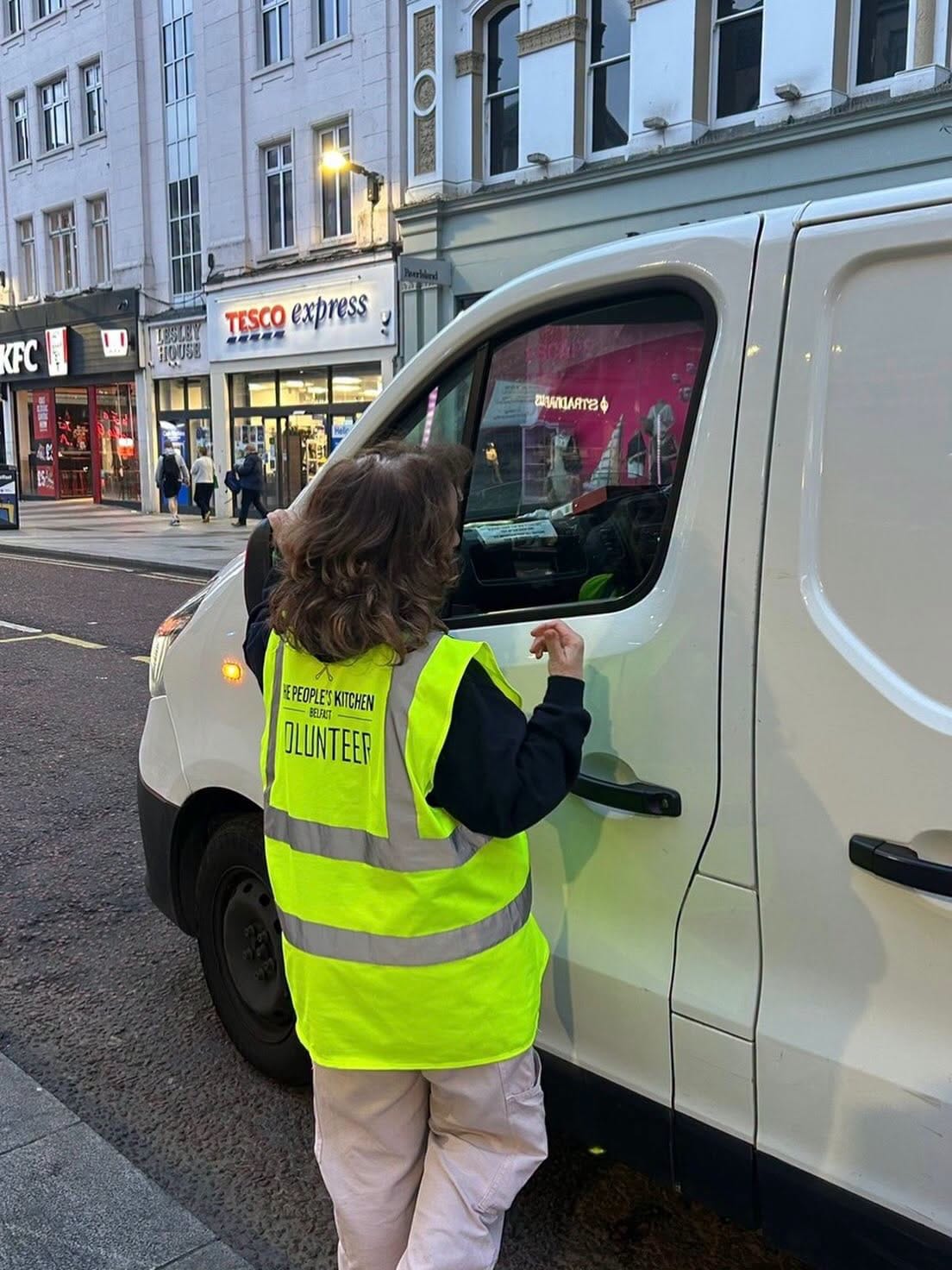
Now in its fourth day, Belfast is busy as thousands of visitors continue to descend on the city to celebrate Fleadh Cheoil na hÉireann. The Fleadh is one of the most high-profile events that Belfast has ever hosted. It will shine a light on the city’s long cultural heritage, and we are right to feel proud and excited. But underneath the celebrations, for people living in poverty, and the homeless population of Belfast, life will carry on as normal. And for some, their day-to-day existence may prove to be even more difficult for the duration of the festival. With this in mind, The Peoples Kitchen, one of our funded projects, will be increasing their outdoor relief activities throughout the week, extending opening hours at their drop-in centre on the Antrim Road, preparing even more hot meals than usual, and working closely with other outreach organisations to provide help and shelter for those in need.
When we heard about The People’s Kitchen plans, it got us thinking about the origins of outdoor relief in Belfast, and the role that Belfast Charitable Society played in helping the poor of what was then a burgeoning town. While the Poor House was under construction, Belfast Charitable Society established a badged poor system across Belfast, essentially giving those identified as the poorest of the town a permit to beg on the streets. Strict rules applied, and beggars could only avail of a badge if they had lived in the parish of Belfast for at least one year.
When the Poor House opened its doors in 1774, it became evident that one building with limited facilities was not going to solve the increasing problem of poverty in Belfast. For many people, especially those who were homeless or infirm, the Poor House was a godsend. But many others who were facing extreme hardship didn’t want to live in an institution, preferring to remain in their own homes, and continue working where they could. So the Society introduced an official outdoor relief scheme to provide financial and practical assistance to the poor of Belfast in their own homes.
As with the Poor House, funding for the scheme came from private donations and public subscriptions. Subscribers who donated at least one guinea could vote at the Society’s annual committee elections. They were also granted the power to sign petitions on behalf of those seeking entry to the Poor House, and recommend families and individuals who lived in their district for outdoor relief. As word about the scheme spread, both the demand for assistance from Belfast’s poorest residents, and a willingness to help from its wealthiest citizens, steadily increased. As petitions for outdoor relief far outstripped requests for admittance to the Poor House, Belfast Charitable Society soon realised that helping people within their own home environment was both socially and economically advantageous, and the scheme came to dominate its work. In 1776, it received 160 petitions from the “out poor” and within twenty years that figure had almost trebled.
Initially, assistance granted through the scheme was purely financial. An early record shows a donation to a Mr Gillespie of Sandy Row to help him and his two daughters through a period of ill health. And in 1779, Dolly McGarety of Saltpan Lane, applied for and received financial relief when her family experienced a time of extreme hardship. Her request was granted, along with a further donation to her husband, a pedlar by trade, specifically to purchase peddling goods. The Society realised that getting Mr McGarety back to work was the best long-term option for the family.
Supporting people to earn a living became one of the scheme’s core objectives. A small cotton spinning business had been established inside the Poor House, and as the demand for cotton grew, the Society realised that the out poor could contribute to this flourishing industry. Many people were given money to purchase spinning wheels, including a Mr and Mrs Magill, and a Mr and Mrs Quig. In some instances, an actual wheel was donated instead of the money to buy one. Mary McKinney, a widow with three young children who lived on Hercules Lane, was one of the first such recipients.
Assistance was also granted for the purchase of medicines, for mothers following childbirth, and for individuals left disabled following accidents or illnesses. In 1819, a Mr John Mullan was given five shillings to buy a wooden leg following an amputation operation at the Poor House infirmary.
Throughout the coming decades, Belfast Charitable Society’s outdoor relief scheme would develop and adapt according to the needs of the people it pledged to help. And as the role of the Society itself changed, so did the mechanics of providing financial support, funding training and employment opportunities, assisting those with medical needs, and supplying food and accommodation. Those objectives have always remained at the heart of the Society, and today we proudly support a number of wonderful organisations in Belfast who drive and deliver the same services and facilities.
So if you’re heading to the Fleadh, we hope you have a wonderful time. But spare a thought too for Belfast People’s Kitchen and the outdoor relief work they’ll be doing in the coming days. Paul McCusker from People’s Kitchen said:
“Our team are still on the streets, thank you to everyone for all their hard work in going above and beyond for those presenting from 8.30am this morning and everyday at the People’s Kitchen. It will be a long week but certainly highlights that if we all join up and work together we can make a huge difference to many lives for those who have to call the streets their home.”