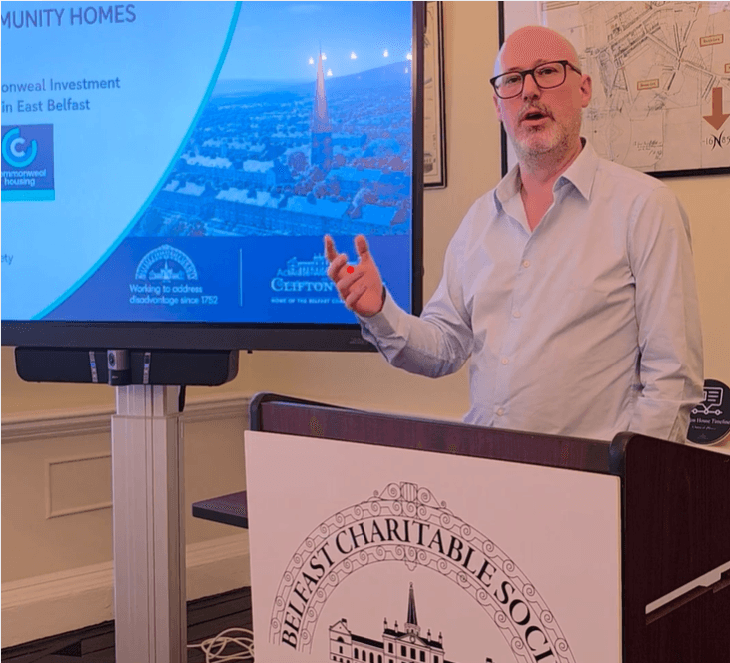
Clifton House hosted a very special event today, which facilitated the sharing of a new community-led housing initiative in East Belfast to help people who have been experiencing long-term homelessness. Spearheaded by Hosford Community Homes Ltd, and helped by a grant provided by Belfast Charitable Society and matched by Ulster Garden Villages, Hosford Housing were able to meet the funding criteria to access a government loan through the Financial Transactions Capital scheme, enabling them to buy more vacant properties to meet the current homeless need.
Today’s event took place one week after the 274th anniversary of the formation of Belfast Charitable Society, when, on the evening of 28 August 1752, nineteen Belfast businessmen gathered at the George Inn on North Street. This was not a social occasion. The sole mission of these philanthropic men, known since that evening as the Society’s founding fathers, was to address poverty and homelessness in their rapidly developing town, and specifically, to build a poorhouse and infirmary. It would take twenty-two years to complete, but finally, in late 1774, the Belfast Poor House, now Clifton House, welcomed its first residents.
There was a certain synchronicity to the timing of today’s Hosford event, and it got us thinking about the origins of the Society, the motivations of those founding fathers, and the history of the building. The founding fathers may not have ever considered the Belfast of the 21st century, but if they did, they most likely envisaged a future where poverty and homelessness were eradicated. Sadly, as we are only too aware, the need for charity and philanthropy is as crucial today as it was in 1752. Over the past two and a half centuries, Belfast Charitable Society has remained true to the objectives of the founding fathers, and to the men and women who ran the Poor House, managed the infirmary, and introduced multiple initiatives to help the poor and sick of their town. The shape of the Society may have changed, but its core values have not, and alleviating homelessness is still one of its key strategic aims. So the new Hosford Housing project is a welcome and vital venture, and Clifton House was the perfect venue to discuss and share it. We know the scheme will change lives, just as the Poor House did in the 18th and 19th centuries for hundreds of individuals and families, people like Ann Curran and John Trimble.
Ann Curran first entered the Poor House infirmary in August 1775. A pauper woman with several children, Ann was desperate to return to her family, but due to her illness spent almost two months in an infirmary bed. A few weeks after her discharge however, Ann requested readmission to the Poor House, and this time she asked if her youngest child, a girl, could accompany her. Until that point, children were not admitted to the Poor House, but something about Ann and her situation touched the Society’s committee members, and that little girl became the first of over one thousand children to be welcomed through its doors between 1775 and 1882. Ann was a talented seamstress, and she was occasionally tasked with making garments for some of the other occupants of the house. She also began to teach some of the teenage girls who entered the house to sew, an early example of Belfast Charitable Society’s apprentice scheme. Ann and her daughter finally left the Poor House in October 1778. She was officially employed by the Society as a seamstress, given a regular wage, and gifted a small house on Poor House Row, a street that ran alongside the building, for herself and her children to live in.
John Trimble entered the Poor House in 1858, eighty years after Ann left it. He was just seven years old at the time, not quite an orphan, but his widowed mother was unable to look after him. John lived in the house until he was fourteen when he was given a live-in apprenticeship with Mr Reed, a printer, stationer, and bookseller based in Waring Street. After his apprenticeship, John relocated to Leeds where he became a successful businessman. He never forgot the Poor House though, nor the life-changing opportunity bestowed upon him by Belfast Charitable Society. In 1878, he made the first of what would become a life-long annual donation to the Society. The donation was accompanied by a heartfelt letter.
“Having spent years of my boyhood under the Poor House roof, I cannot express the gratitude I feel to those gentlemen who sacrificed time and money to the good purpose of educating and supporting the orphan who would otherwise have been led into a life of vagrancy, pauperism, and possibly crime.”
John Trimble’s annual donation continued until his death in 1929. In his will, he bequeathed a final donation of £250, and a percentage of his estate.
Ann and John’s stories are just two of many on our records, two lives that Belfast Charitable Society has helped to change since its inception in 1752. We know that as Hosford Housing moves forward with their new community-led housing scheme, many more lives will be changes, and many news stories will be written, and we wish them well.